

















Refrigerated transport and cold chain logistics have become a strategic pillar within the supply chain, especially in critical industries such as food and pharmaceuticals.
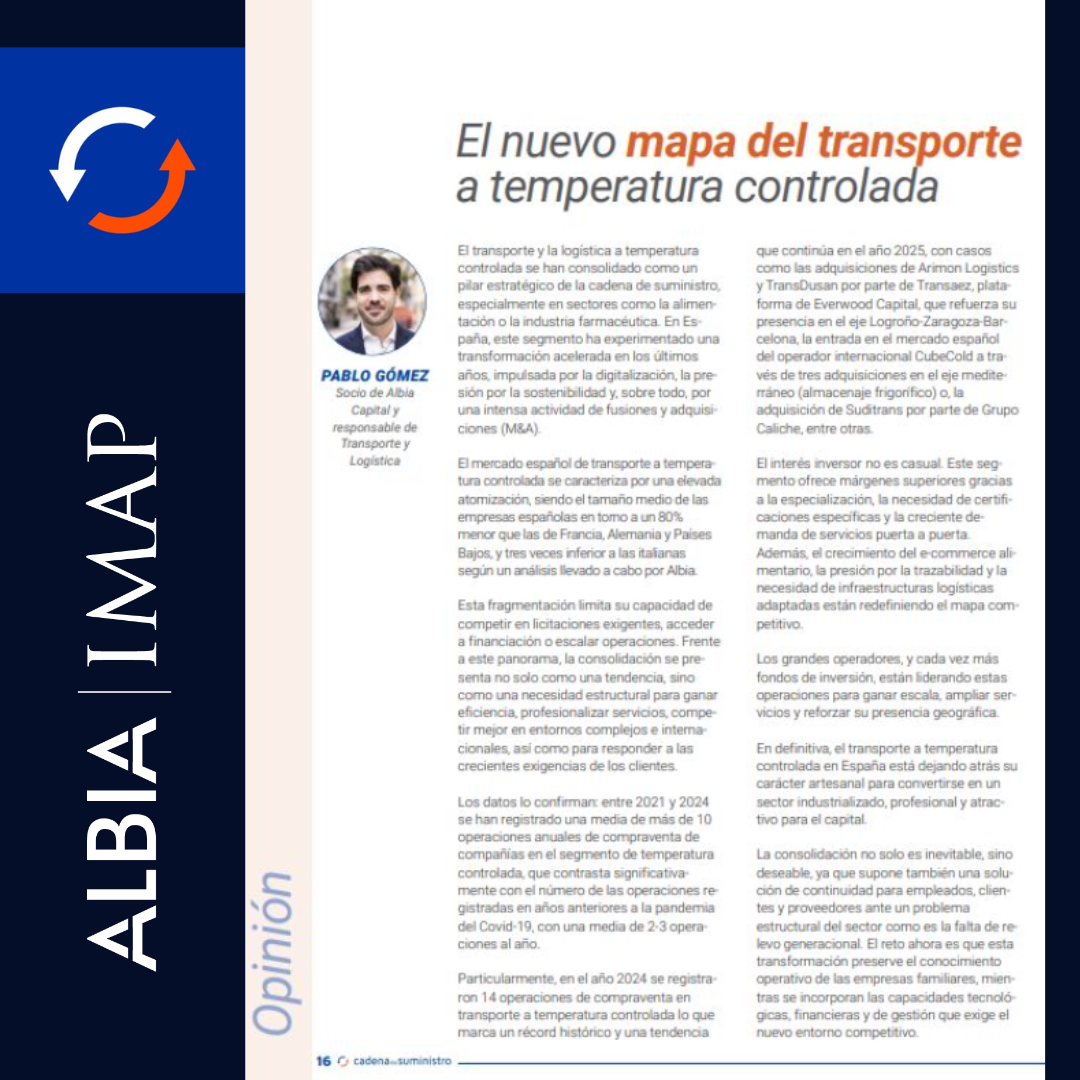
In an interview with the magazine Cadena de Suministro, Pablo Gómez, Partner at Albia IMAP, analyzes how this segment has moved in just a few years from being highly fragmented to becoming a focus of attraction for investors and international funds, driven by the strong momentum of Mergers and Acquisitions (M&A).
A fragmented market compared to Europe
According to data provided by Albia IMAP, the Spanish refrigerated transport market is characterized by significant fragmentation: the average size of national companies is 80% smaller than their competitors in France, Germany, or the Netherlands, and three times smaller than Italian operators.
This fragmentation limits companies’ ability to compete in international tenders, access financing, or scale operations. In this context, business consolidation is not only a trend but also a structural necessity to increase efficiency and professionalize the sector.
Record-breaking M&A activity
The numbers confirm this trend: between 2021 and 2024, more than 10 annual transactions involving the sale and purchase of refrigerated transport companies were recorded in Spain. This dynamism contrasts with the average of 2–3 transactions per year seen before the Covid-19 pandemic.
In 2024, the market reached 14 deals, setting a record. The trend continues in 2025, with notable operations such as:
- The acquisitions of Arimon Logistics and TransDusan by Transaez (Everwood Capital).
- CubeCold’s entry into the Spanish market with three acquisitions along the Mediterranean corridor.
- The acquisition of Suditrans by Grupo Caliche.
Drivers of investment interest
Investor appetite in this sector is no coincidence. Refrigerated transport offers higher margins thanks to:
- A high level of specialization.
- The requirement for specific certifications.
- The growth of food e-commerce and increasing demand for traceability.
- The need for modern, sustainable logistics infrastructures.
In this environment, large operators and investment funds are leading M&A activity to gain scale, expand services, and strengthen their geographical footprint.
From artisanal to industrialized
Refrigerated transport in Spain is evolving from a traditional, family-owned model into a sector that is increasingly industrialized, professional, and attractive to capital. This transformation not only responds to competitiveness requirements but also ensures the continuity of many companies facing structural challenges such as the lack of generational succession.
The main challenge now is to preserve the operational know-how of family businesses while incorporating the technological, financial, and managerial capabilities demanded by the new competitive environment.
Albia IMAP’s perspective
At Albia IMAP, we support logistics companies and investment funds in their M&A and corporate finance operations, combining global vision with deep local expertise. Our goal is to facilitate consolidation processes that create sustainable value for companies, employees, customers, and suppliers.