


















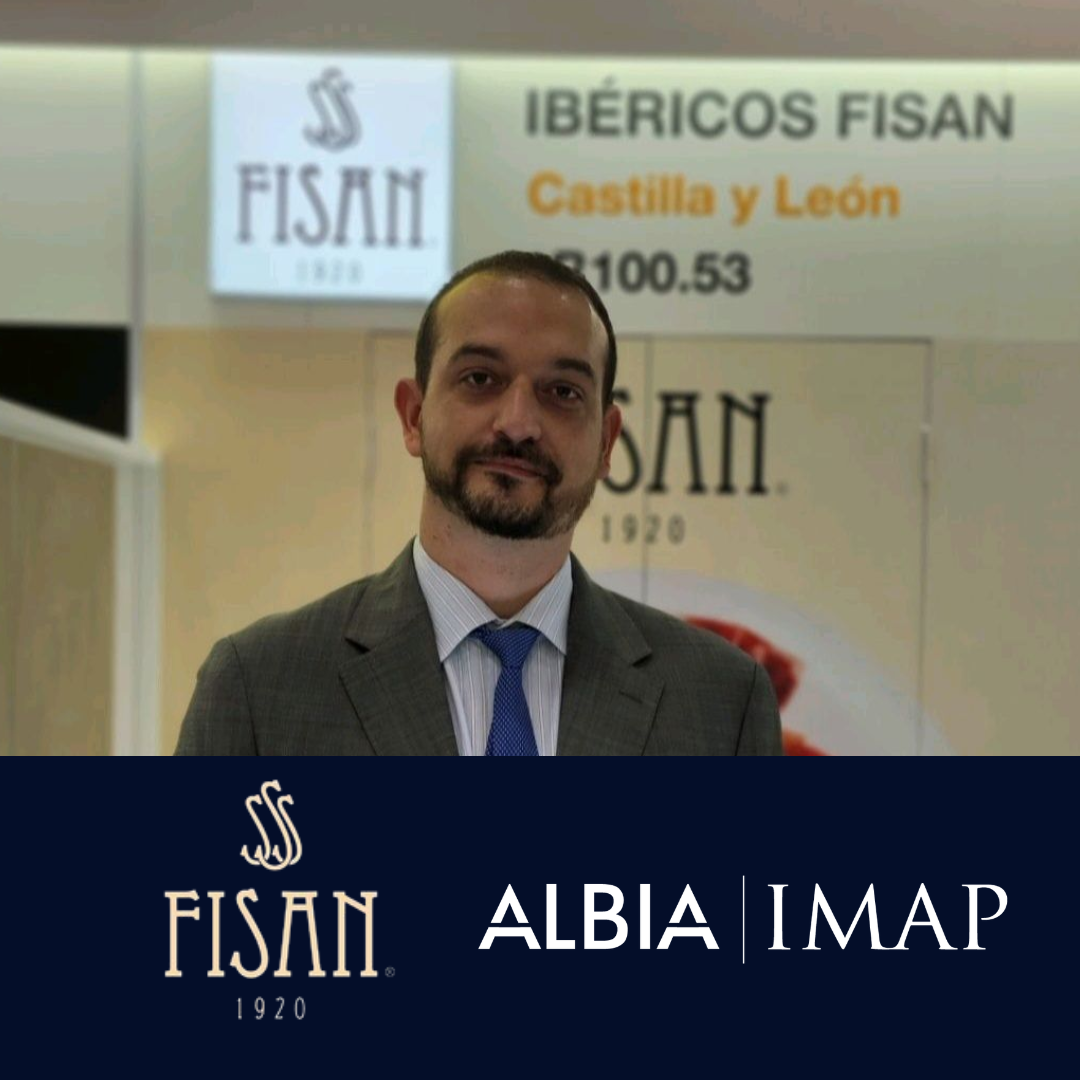
Interview | Iberian products in Spain: competitiveness, brand, sustainability, traceability and new consumer habits
In Albia IMAP’s M&A Report – Meat Industry (2026), we speak with Felipe González, Export Manager at Ibéricos Fisan, to explore the dynamics of the Iberian (jamón ibérico) sector and its evolution in Spain and international markets. The interview covers the factors currently shaping competitiveness—cost pressure, the need for scale and building brand reputation—as well as the role of marketing and storytelling in educating consumers. It also highlights the importance of innovation in product formats (sliced products, hand-carved cuts in protective atmosphere packaging) to reduce seasonality. Finally, it looks at the growing relevance of online channels, the importance of traceability and food safety (standards such as IFS/BRC), and how sustainability can strengthen value-added positioning and brand perception.
Here is the interview:
In this interview, we take a closer look at the dynamics of the Iberian segment in Spain. More specifically, Felipe González, Export Manager at Ibéricos Fisan, shares his view of the industry, as well as the main trends:
Which factors do you consider most decisive today for the competitiveness of the Iberian sector, both in the domestic and international markets?
Today, being truly competitive is increasingly difficult, given that sales margins have been reduced to a minimum due to the constant rise in costs—especially raw materials, live pigs and even the butchering process.
I believe investing in brand reputation is essential to improve competitiveness in the medium and long term. Otherwise, the open price war based on low prices and volume products means that competing without economies of scale is unsustainable for a small producer. This is why large pork companies have gained significant importance in the sector in recent years: many small and mid-sized companies cannot compete because of rising costs that they have not been able to pass on to the final product price, leading to margin loss and the disappearance of many companies in the sector.
Another important factor is marketing and storytelling, together with transparent product communication, so that consumers have accurate information about what they are buying—why they should buy this brand and not another, or this quality level rather than another. If differentiating these details is difficult in Spain, abroad it is almost impossible. Therefore, as a sector, it is necessary to continue educating end consumers, as has been done in recent years through dedicated campaigns (or by the companies themselves in a more “grassroots” way, supporting their customers directly).
Finally, I would highlight innovation and, above all, adapting to today’s demanded formats (such as protective-atmosphere packaging for hand-carved slices). This is key, as is having recognised food safety standards such as IFS or BRC.
How is the evolution of consumption (new generations, health, distribution channels) affecting Iberian companies’ strategies?
I believe changes in consumption are positively affecting the sector and companies’ strategies. While it is true that you must “adapt or die,” most companies have evolved in step with consumer trends. Many companies have opted out of this evolution, but because their business model is different—either doing contract processing and curing pieces for other manufacturers, or focusing on selling semi-processed products or even by-products from Iberian pigs.
However, within the Iberian products segment—such as jamón, shoulder ham and cured meats—I think new consumer habits are having a positive impact. Not long ago, Iberian ham was mainly enjoyed in restaurants or at family dinners during Christmas. Now, with new formats like hand-carved and sliced products, it can be enjoyed all year round, and I think the product is not as seasonal as it once was (even though the highest share of annual sales still occurs during the Christmas campaign). Today, we can see how consumption of sliced and packaged formats keeps increasing and is in higher demand, to the detriment of whole pieces—so seasonality is not as pronounced as it used to be.
From a health perspective, there is still a lot to do to educate consumers and communicate the benefits of Iberian ham and its fat—particularly acorn-fed Iberian ham, given its high oleic acid content. Even today, there are people (and internationally even more so) who avoid fat because they label it as negative, without considering what type of fat it is and whether it is healthy. But several studies suggest that Iberian ham (including its fat) is good for health, so in this respect the sector benefits from new habits and advances.
As for distribution channels, online purchases are increasingly influential (with clear year-on-year growth in online sales). However, the bulk of Iberian products sales is still in hospitality (although retail should not be neglected, where large volumes of Iberian products are sold, albeit with limited value added). Therefore, in this sense there has not been a major shift compared to a few years ago, except for the steady increase in online sales, which still has a rather residual weight but does represent a growing volume for companies year after year.
For all these reasons, segmenting by generations, diversifying formats, and knowing how to communicate through the different available channels are key to adapting to new consumption trends and habits across population segments.
What role are sustainability and traceability playing in your company’s value-added strategy?
Product traceability has always been important, but even more so since the 2014 Iberian Standard, when different products began to be classified with different quality seals. That is why today traceability—and increasingly, food safety—are key in the sector.
Regarding sustainability, it is true that companies tend to invest in this area, but personally I believe it is mainly for internal reasons rather than commercial or sales purposes. It is true that, for example, many efforts have been made in recent years around green energy, carbon footprint, livestock farming practices, etc. All of this influences a company’s competitiveness, but it does not have a very direct impact; rather, it affects sales indirectly. That said, you can build strong storytelling around sustainability, animal welfare, the use of clean energy and reduced carbon footprint to connect with end consumers and improve brand image.
So yes—both are important in the company’s value-added strategy, but not so much if we focus on the end customer.
Do you think the Iberian sector should undertake a more ambitious process of consolidation or business collaboration to gain scale and visibility?
I think the sector’s idiosyncrasy has always been highly fragmented, with many small and mid-sized companies and few large ones. I believe maintaining all those small and mid-sized companies—most of them family businesses—is a priority for the sector. I do not think giving up family history and tradition is the best path, even though increasingly there are large companies concentrating more and more market share and influence, which forces small and mid-sized companies to modernise within their means or face a fairly uncertain future.
As for business collaboration among companies in the sector, efforts have been promoted for some years, but for one reason or another, to date there has not been a union like in other sectors to defend common interests. I believe the potential of the Iberian sector is more than proven, but it is also true that, organisationally and collaboratively, it is one of the most independent sectors, with companies that avoid these collaboration agreements because they do not see them as relevant or believe they are not necessary for growth—not only for individual companies, but for the sector as a whole. Even so, major efforts are being made to achieve this collaboration through various institutions (such as ASICI or ANICE), but I think that most of the time there is not the backing of a majority of companies in the Iberian sector, and this limits the possibility of better collaboration between companies and institutions.
Download the M&A report on the meat sector by clicking here.