


















Global M&A Trends 2026: Selectivity, Sophistication and New Opportunities in a Transforming Market
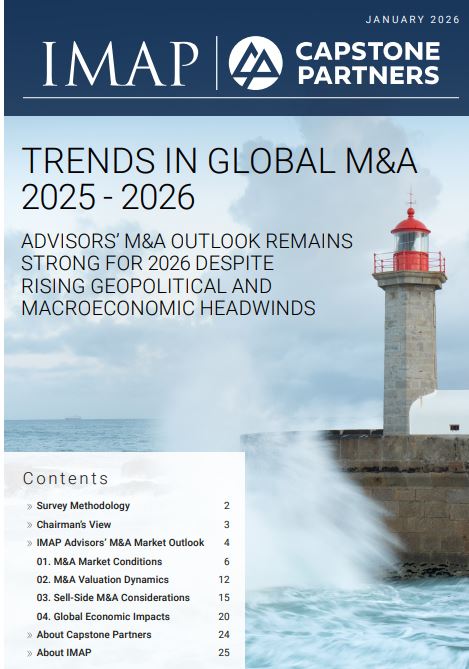
The new IMAP Global M&A Trends 2025–2026 report reveals an M&A landscape marked by moderate optimism, growing sophistication, and a clear reconfiguration of priorities among buyers, sellers, and investors. Despite a complex geopolitical environment and economic volatility, advisors anticipate a dynamic 2026—especially for companies that position themselves strategically.
1. A Resilient Market Approaching 2026 with Optimism
Globally, 72.6% of advisors expect an increase in deal flow in 2026—a high figure, albeit slightly lower than for 2025. This optimism is supported by several factors:
a) The gradual return of private equity funds after years of reduced activity due to high interest rates.
b) Improved access to financing driven by more accommodative credit conditions.
c) More contained inflation, reducing uncertainty in valuation and deal execution.
Regions such as Asia show the strongest enthusiasm, with a notable rise in growth expectations, while Europe and North America maintain positive but more moderate forecasts.
2. Cross-Border Deals: Latin America and EMEA Drive International Activity
Cross-border dynamics are gaining renewed relevance. In 2026, Latin America leads optimism with a 27.6% increase in expectations for international M&A growth, followed by EMEA and North America. The region benefits from:
- Nearshoring and industrial relocation
- More attractive valuations in relative terms
- Growing interest from international buyers in energy, infrastructure and digitalization sectors
3. Private Equity: A Key and Increasingly Selective Player
Private equity funds will continue to set the pace of the market. For 2026, 45.3% of advisors expect greater activity from PE, driven by:
- High levels of dry powder
- A pipeline fueled by deals postponed in previous years
- The need to rotate portfolios and pursue exits
The most attractive sectors for investors will be:
- Business Services
- Technology, Media & Telecom (TMT)
- Healthcare
- Aerospace & Defense, driven by geopolitical tension
4. Challenges for 2026: Uncertainty and Valuations
The main factors that could delay or hinder M&A deals in 2026 include:
a) Economic volatility (cited by 56.6% of advisors).
b) Tariff and international trade policies, which continue to create friction among markets.
c) Unrealistic valuation expectations—highlighted by nearly half of professionals.
Operational challenges also include weak revenue forecasts, earnings quality, and dependence on key customers.
5. Seller Motivations: Consolidation and Succession
In 2026, business succession solidifies as one of the primary drivers of transactions, alongside sector consolidation. Aging owners, competitive pressure, and the need to gain scale are pushing many companies to consider a sale or integration process.
An increase in global expansion and vertical integration deals is also observed, driven by changes in supply chains and the need to diversify risk.
6. What Are Buyers Looking For?
Visibility, Margin, and Recurrence** One of the clearest findings of the report is the growing importance of predictability. In 2026, buyers will prioritize:
a) Recurring revenues (the #1 criterion for 66% of advisors)
b) Strong margins
c) Defensible cashflows
This preference is even stronger in sectors facing greater regulatory pressure or international volatility.
7. Valuations: Stability with Asian Leadership
For 2026, most advisors expect stability in EBITDA multiples, with slight increases. Global estimated averages are:
- Typical multiple: 6.8x EBITDA
- Premium multiple: 9.8x EBITDA
By region, Asia is expected to lead valuations, followed by North America, while EMEA and Latin America show more moderate multiples due to volatility among local central banks.
2026 Will Be a Year of Opportunities… for Those Prepared
The global M&A market enters 2026 as a less exuberant yet more sophisticated environment. Selectivity will be key: more demanding buyers, more strategic sellers, and a geopolitical context requiring detailed planning. For companies seeking to grow, diversify, or execute generational transitions, the upcoming year offers clear opportunities—provided they are approached with foresight, realistic valuation expectations, and solid positioning.