


















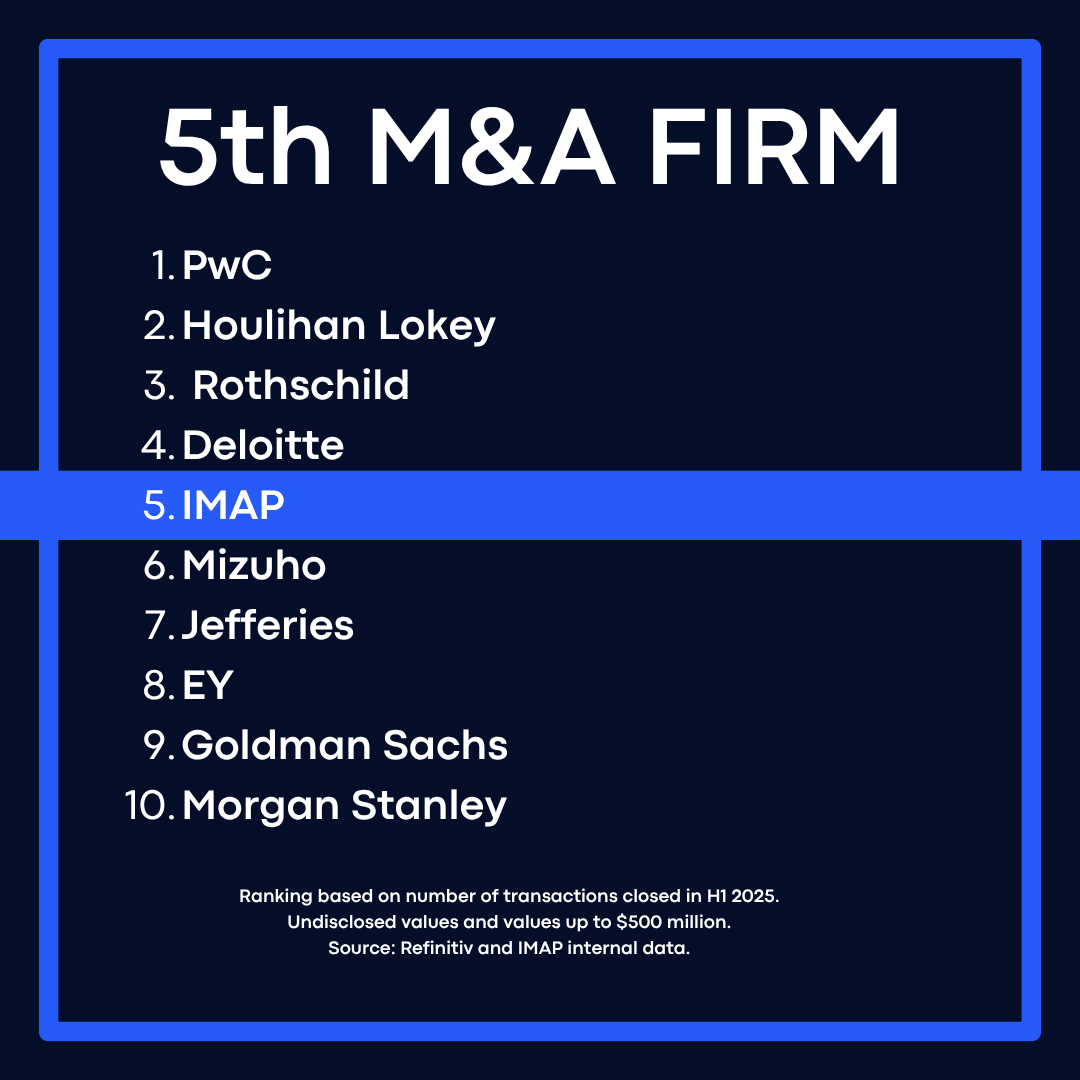
The middle-market experienced a fairly steady flow of deal activity in H1 despite global uncertainty over new U.S. tariffs and shifting trade policies. Activity briefly slowed at the start of Q2, with many deals paused as investors evaluated tariff impacts on planning and valuations, especially in the Consumer, Manufacturing, and Automotive sectors. However, the May trade agreement between the U.S. and U.K. indicated a shift toward resetting trade relations rather than escalating tensions. The consensus is now that the U.S. is aiming to rebalance trade relations with China. Meanwhile, the market is stabilizing as volatility eases and dealmakers adjust, similar to previous periods of inflation and rate hikes. Strategic buyers, both public and private, continue to drive deal momentum.
In this mixed context of caution and opportunity, IMAP dealmakers closed 108 M&A transactions worldwide, totalling over USD 8 billion in the first half of 2025. More than a third of IMAP transactions in H1 were cross-border as dealmakers leveraged IMAP’s global reach to help clients capitalize on international opportunities. From a sector perspective, IMAP was most active in the Consumer, Services, Technology, and Industrials segments.
Looking ahead, market fundamentals continue to support strong M&A activity, especially in the resilient and strategically relevant middle-market. Despite ongoing uncertainty around U.S. economic and trade policies, core drivers remain intact. Founder-led businesses are increasingly entering the market due to accelerated succession and generational transitions. Meanwhile, PE firms face growing pressure to exit long-held portfolios, boosting target supply. On the demand side, both financial and strategic investors remain well-capitalized with significant dry powder, driving strong com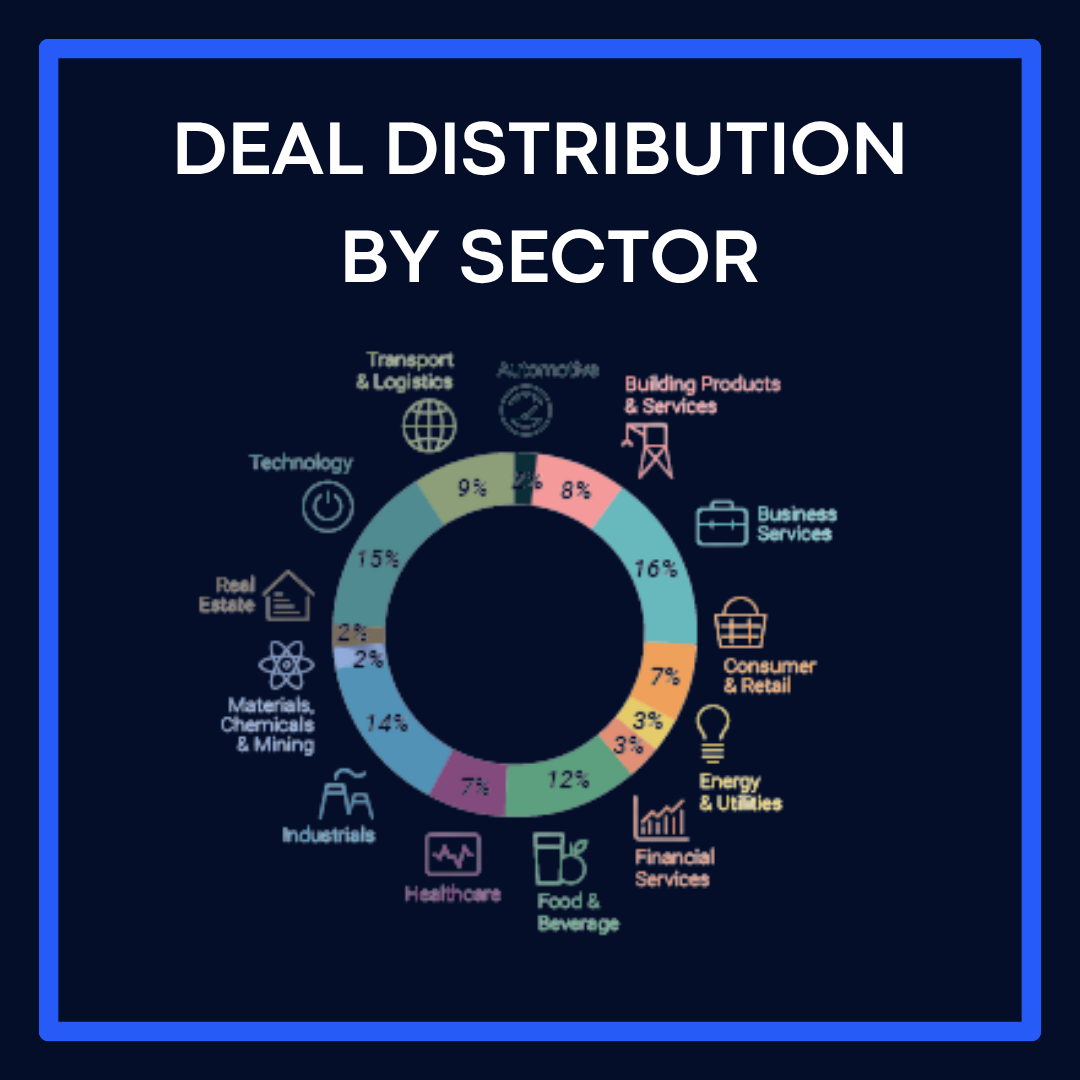 petition for quality assets. Companies with pricing power and stable earnings visibility attract the most buyer interest, as predictability is highly valued in today’s volatile environment. Although investor appetite and deal volume remain high, transactions are taking longer to close due to heightened risk aversion, increased diligence, and more complex deal structures.